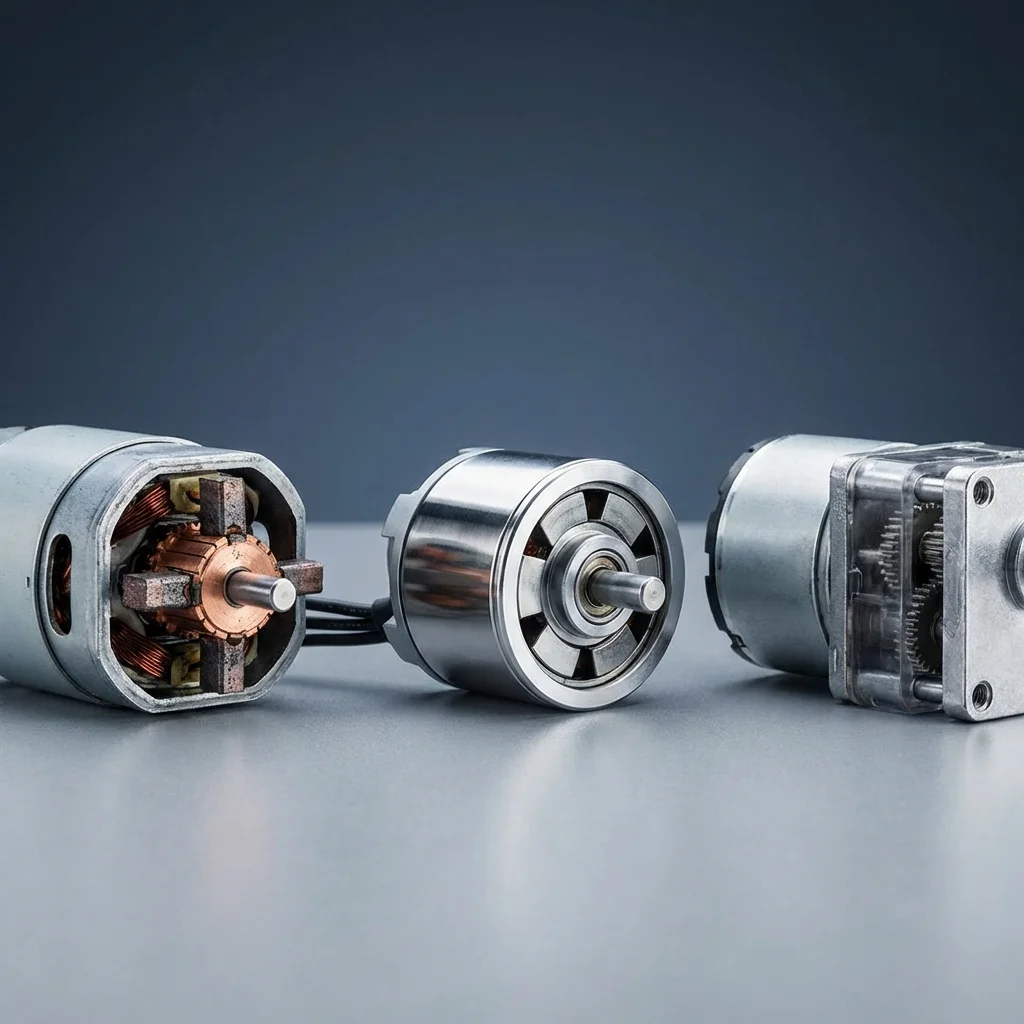
Choosing the right DC motor can make or break your maker project. Whether you’re building a robot arm that needs precise positioning, a drone that demands efficiency, or a simple fan that just needs to spin — understanding motor types and specifications is essential.
In this guide, we’ll break down the three main types of DC motors, explain the critical torque-speed relationship, and give you a simple decision framework to pick the perfect motor.
Understanding motor specifications
Before comparing motor types, let’s understand the three key specifications you’ll encounter:
RPM (speed)
Revolutions per minute — how fast the motor shaft rotates. Higher RPM means faster rotation.
Torque
The rotational force the motor can provide. Measured in N·m or kg·cm. Higher torque means more pushing power.
Voltage
The electrical potential that drives the motor. Must match your power supply (3.3 V, 5 V, 12 V, 24 V, etc.).
The three types of DC motors
1. Brushed DC motors
The most common and affordable motor type. Uses carbon brushes that make physical contact with the commutator to transfer electrical current.
- Pros: cheap, simple to control (just apply voltage), widely available.
- Cons: brushes wear out over time, generate electrical noise, less efficient.
- Best for: toys, simple robots, fans, low-budget projects.
2. Brushless DC motors (BLDC)
Uses electronic commutation instead of physical brushes. The magnets are on the rotor and the coils are on the stator.
- Pros: high efficiency (85–90%), longer lifespan, less noise, compact and powerful.
- Cons: requires an ESC (electronic speed controller), more expensive, complex control.
- Best for: drones, electric vehicles, high-performance robotics, cooling fans.
3. Geared DC motors
A brushed or brushless motor with an integrated gearbox that trades speed for torque.
- Pros: very high torque output, precise positioning possible, slow and controlled movement.
- Cons: lower maximum speed, heavier, potential gear backlash.
- Best for: robotic arms, conveyor belts, actuators, heavy lifting applications.
Motor type comparison
Use this comparison to quickly identify which motor type fits your needs:
| Type | Speed | Torque | Cost |
|---|---|---|---|
| Brushed DC | High | Low | Low |
| Brushless | High | Medium | High |
| Geared DC | Low | High | Medium |
The torque vs speed trade-off
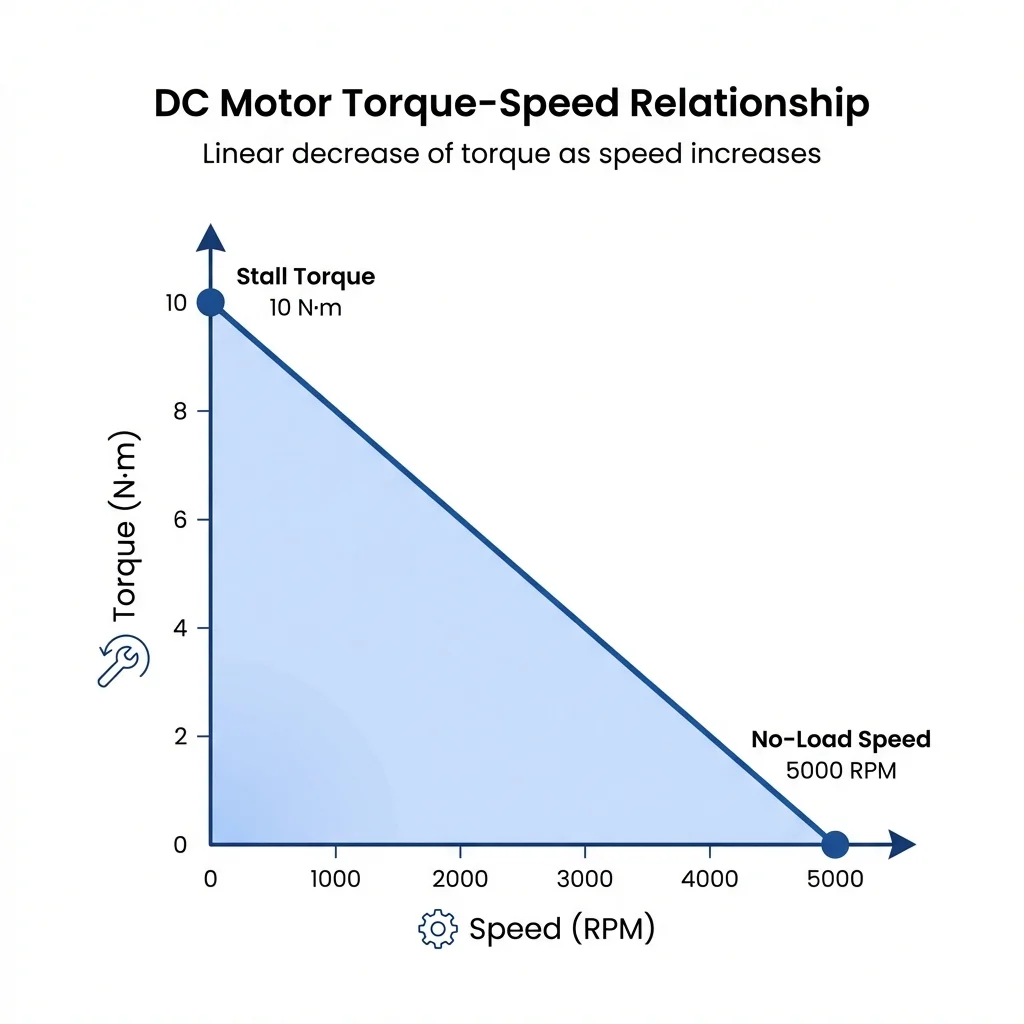
This is the most important concept to understand: torque and speed are inversely related. When a motor operates under load:
Decision flowchart: finding your motor
Use this simple flowchart to narrow down your motor choice:
Motor selection guide
↓ YES
↓ NO
↓ YES
↓ NO
Practical examples
| Project | Recommended motor |
|---|---|
| Simple line-following robot | Brushed DC with L298N driver |
| Quadcopter drone | Brushless DC with ESC |
| Robotic arm joint | Geared DC or servo motor |
| Automatic curtain opener | Geared DC with H-bridge |
| Electric skateboard | High-power brushless DC |
Summary
Selecting the right DC motor comes down to understanding your project’s requirements:
- Need it cheap and simple? → brushed DC.
- Need efficiency and long life? → brushless DC (BLDC).
- Need high torque for heavy loads? → geared DC.