⚡ Calculate Battery Runtime
📐 Battery Life Formula
The formula accounts for the usable capacity based on your chosen depth of discharge, giving you a more realistic runtime estimate that also helps preserve battery lifespan.
🔬 Battery Technology Comparison
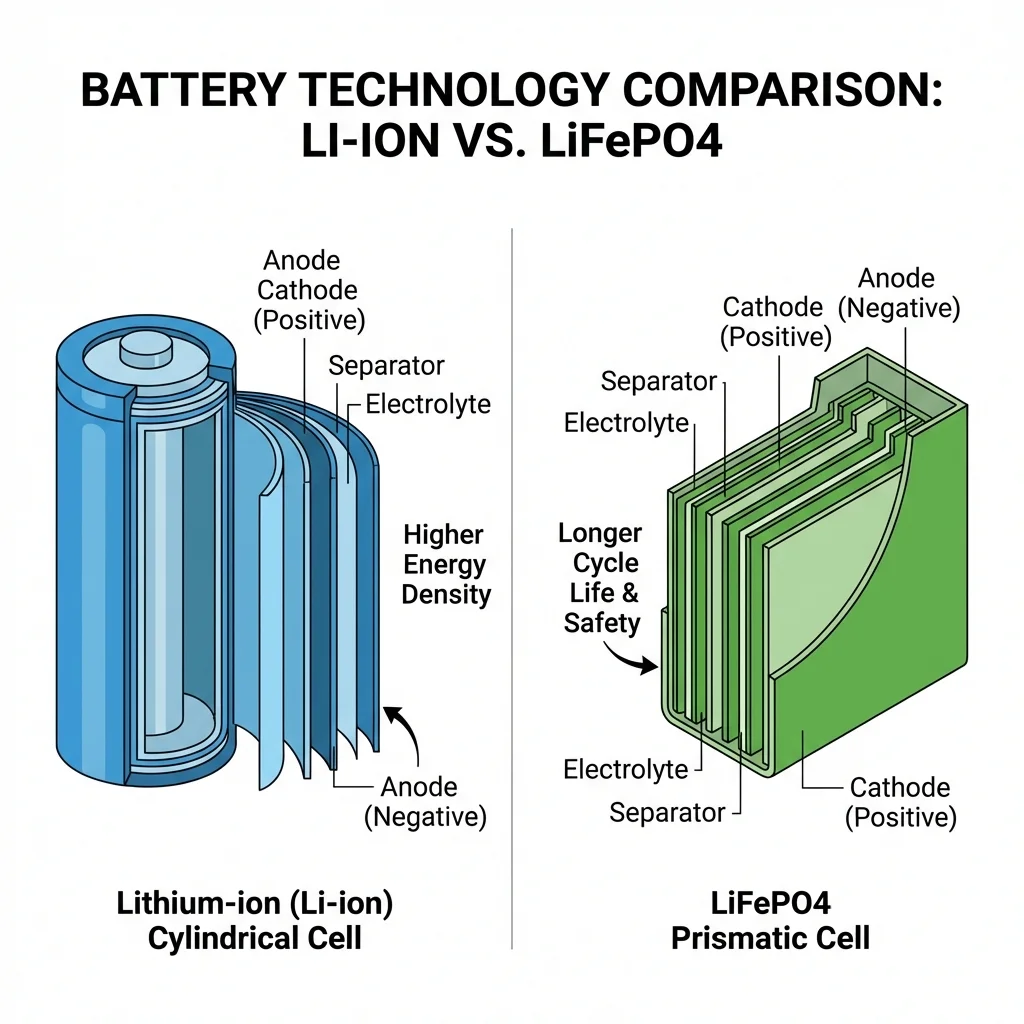
Figure 1: Internal structure comparison of Li-ion cylindrical cell and LiFePO4 prismatic cell
📊 Understanding Depth of Discharge (DoD)
Depth of Discharge (DoD) refers to the percentage of battery capacity that has been used relative to its total capacity. It's one of the most critical factors affecting battery lifespan.
Why DoD Matters
- Shallower discharges (lower DoD) significantly extend cycle life
- Deep discharges (high DoD) stress the battery chemistry and reduce longevity
- Optimal range: 20-80% state of charge for daily use
- Emergency use: 100% DoD acceptable occasionally but reduces overall lifespan
50% DoD
Can provide 2-3x more cycle life compared to 100% DoD. Ideal for applications requiring maximum longevity.
80% DoD
Standard recommendation for most applications. Good balance between usable capacity and battery lifespan.
🔋 Battery Chemistry Comparison
Lithium-ion (Li-ion)
Li-ion batteries are the most common rechargeable batteries in consumer electronics due to their high energy density and relatively low self-discharge rate.
- Energy Density: 150-200 Wh/kg (highest among common batteries)
- Nominal Voltage: 3.6-3.7V per cell
- Cycle Life: 500-1000 cycles at 80% DoD
- Recommended DoD: 80% maximum for optimal lifespan
- Applications: Smartphones, laptops, power banks, electric vehicles
LiFePO4 (Lithium Iron Phosphate)
LiFePO4 batteries offer superior safety, longer cycle life, and better thermal stability, making them ideal for applications where longevity is critical.
- Energy Density: 90-120 Wh/kg (lower than Li-ion)
- Nominal Voltage: 3.2V per cell
- Cycle Life: 2000-5000+ cycles at 80% DoD
- Recommended DoD: 80-100% (more tolerant of deep discharge)
- Applications: Solar storage, RVs, marine, electric vehicles, UPS systems
Lead-Acid (Flooded)
The oldest rechargeable battery technology, still widely used due to low cost and high surge current capability. Requires regular maintenance including water level checks.
- Energy Density: 30-50 Wh/kg (lowest, very heavy)
- Nominal Voltage: 2.0V per cell (12V = 6 cells)
- Cycle Life: 200-500 cycles at 50% DoD
- Recommended DoD: 50% maximum (deep discharge damages plates)
- Maintenance: Check water levels, clean terminals, avoid overcharging
- Applications: Car starting batteries, UPS backup, golf carts, forklifts
Sealed Lead-Acid / Maintenance-Free (SLA/VRLA)
Sealed versions of lead-acid batteries that don't require water top-ups. Includes AGM (Absorbed Glass Mat) and Gel types. Safe for indoor use and can be mounted in any orientation.
- Energy Density: 30-40 Wh/kg
- Nominal Voltage: 2.0V per cell (12V = 6 cells)
- Cycle Life: 300-700 cycles at 50% DoD
- Recommended DoD: 50% for longevity, up to 80% occasionally
- Maintenance: None required (sealed design)
- Types: AGM (better for high current), Gel (better for deep cycle)
- Applications: UPS systems, alarm systems, emergency lighting, wheelchairs, student projects
| Parameter | Li-ion | LiFePO4 | Lead-Acid | SLA/VRLA |
|---|---|---|---|---|
| Nominal Voltage | 3.6-3.7V | 3.2V | 2.0V/cell | 2.0V/cell |
| Energy Density | 150-200 Wh/kg | 90-120 Wh/kg | 30-50 Wh/kg | 30-40 Wh/kg |
| Cycle Life | 500-1000 | 2000-5000+ | 200-500 | 300-700 |
| Recommended DoD | 80% | 80-100% | 50% | 50% |
| Safety | Good | Excellent | Moderate* | Good |
| Maintenance | None | None | High | None |
| Cost | Medium | High | Very Low | Low |
| Weight (12V 7Ah) | ~0.4 kg | ~0.9 kg | ~2.5 kg | ~2.3 kg |
| Student Friendly | ⚠️ Moderate | ✅ Yes | ❌ No | ✅ Best Choice |
*Lead-acid batteries produce hydrogen gas during charging and contain sulfuric acid
🎓 Best Battery for Student Projects
🏆 Recommended: Sealed Lead-Acid (SLA) 12V
For most student electronics projects, a 12V 7Ah Sealed Lead-Acid (SLA) battery is the best choice. Here's why:
💰 Affordable
SLA batteries cost $15-25 for a 12V 7Ah unit, while equivalent lithium batteries cost $50-100+. Perfect for budget-conscious student projects.
🔒 Safe & Forgiving
Sealed design means no acid spills. Tolerant of minor overcharging and short circuits. Won't catch fire even if damaged (unlike Li-ion).
📦 Easy to Source
Available at any electronics store, UPS repair shops, or online. Standard 12V makes it compatible with many motors, lights, and Arduino projects.
🔧 Simple Charging
Basic chargers are cheap and widely available. No complex BMS (Battery Management System) required unlike lithium batteries.
When to Choose Other Batteries
| Project Type | Best Battery | Why |
|---|---|---|
| Robotics / Mobile | SLA 12V 7Ah | Affordable, high current for motors |
| Drone / Weight-Critical | Li-Po / Li-ion | Lightweight, high discharge rate |
| Solar Project | LiFePO4 or SLA | Deep cycle capability, safe |
| Wearables | Li-Po (small) | Compact, flexible form factors |
| Arduino/ESP32 Portable | 18650 Li-ion | 3.7V matches MCU voltage, compact |
| High-Power Motors | LiFePO4 | High current, long cycle life |
⚠️ Safety Tips for Students
- Never short-circuit any battery - it can cause fire or explosion
- Use appropriate fuses in your circuit (always!)
- Don't puncture, crush, or heat batteries
- For Li-ion/LiFePO4, always use proper BMS boards
- Charge batteries in a fireproof location, never overnight unattended
- Dispose of old batteries properly at recycling centers