ADXL345 3-Axis Accelerometer
Complete Tutorial: Motion Detection, Tilt Sensing & Tap Detection
1. Introduction
The ADXL345 is a small, thin, ultra-low power 3-axis accelerometer made by Analog Devices. It measures static acceleration (like gravity for tilt sensing) and dynamic acceleration (from motion, shock, or vibration).
What makes it special is its built-in motion detection features: single tap, double tap, free-fall detection, and activity/inactivity monitoring—all handled by the sensor itself!
📦 Key Features
- High resolution: 13-bit, up to ±16g range
- Ultra-low power: 23µA in measurement mode
- Built-in tap and free-fall detection
- Dual I2C and SPI interface
2. Technical Specifications
| Parameter | Specification |
|---|---|
| Operating Voltage | 2.0V – 3.6V (module: 3.3V – 5V) |
| Interface | I2C (up to 400kHz) / SPI (up to 5MHz) |
| Measurement Range | ±2g, ±4g, ±8g, ±16g (selectable) |
| Resolution | 13-bit (full resolution mode) |
| I2C Address | 0x53 (SDO/ALT low) or 0x1D (SDO/ALT high) |
| Output Data Rate | 0.1Hz to 3200Hz |
| Current (Measurement) | 23 µA typical |
💡 ADXL345 vs MPU6050
ADXL345 is accelerometer-only (no gyroscope) but has better built-in event detection (tap, free-fall). MPU6050 adds a gyroscope but lacks these hardware features. Choose based on your needs!
3. Wiring Guide
| ADXL345 Pin | Description | ESP32 | Arduino Uno |
|---|---|---|---|
| VCC | Power (3.3V-5V) | 3.3V | 5V |
| GND | Ground | GND | GND |
| SCL | I2C Clock | GPIO 22 | A5 |
| SDA | I2C Data | GPIO 21 | A4 |
| CS | SPI Chip Select | VCC (for I2C) | VCC (for I2C) |
| SDO | Address Select | GND (for 0x53) | GND (for 0x53) |
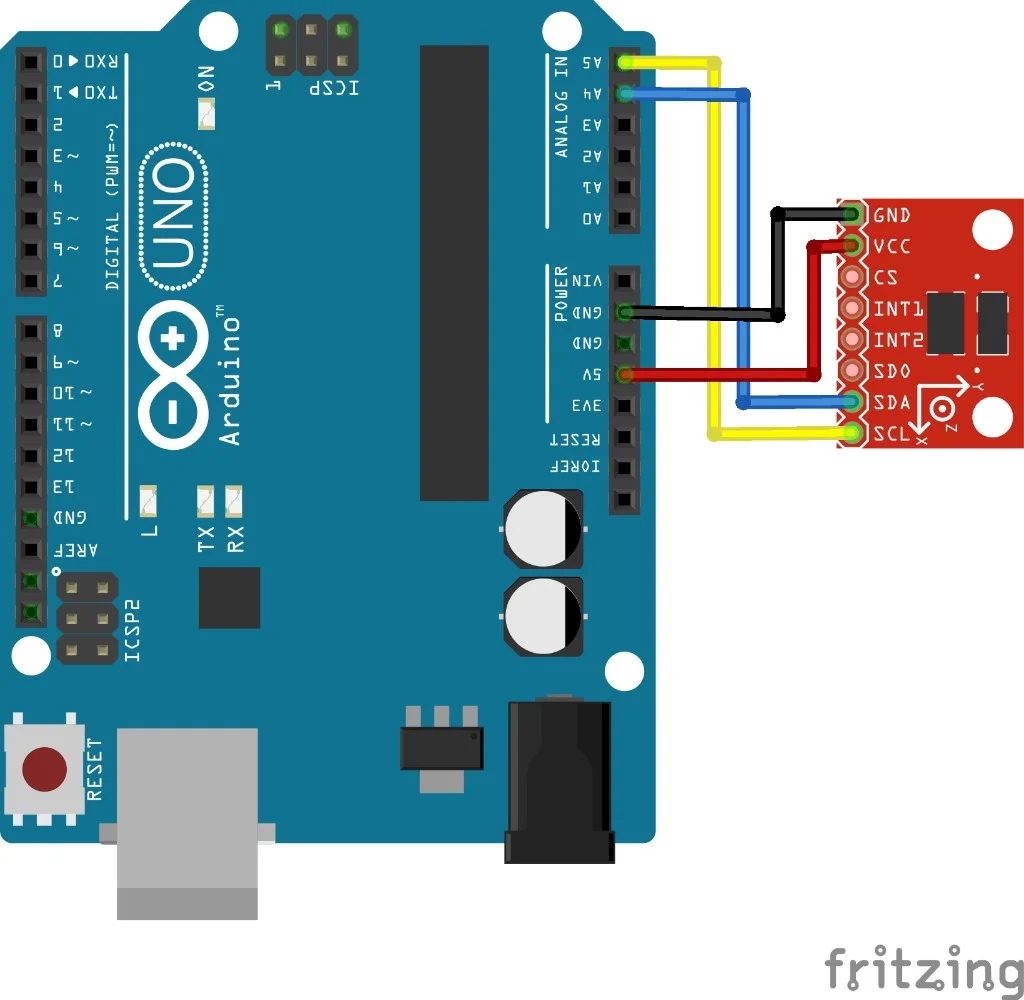
Figure 1: ADXL345 I2C wiring with ESP32
⚠️ Important for I2C Mode
Connect the CS pin to VCC to enable I2C mode. Leaving it floating may cause communication issues.
4. Project: Acceleration & Tilt Monitor
Required Library
Install Adafruit ADXL345 and Adafruit Unified Sensor via Arduino Library Manager.
Basic Acceleration Reading
#include <Wire.h>
#include <Adafruit_Sensor.h>
#include <Adafruit_ADXL345_U.h>

Adafruit_ADXL345_Unified accel = Adafruit_ADXL345_Unified(12345);

void setup() {
    Serial.begin(115200);
    Serial.println("ADXL345 Accelerometer");

    if (!accel.begin()) {
        Serial.println("ERROR: ADXL345 not found!");
        while (1);
    }

    // Set measurement range
    accel.setRange(ADXL345_RANGE_16_G);

    Serial.println("ADXL345 Ready!");
}

void loop() {
    sensors_event_t event;
    accel.getEvent(&event);

    Serial.print("X: "); Serial.print(event.acceleration.x, 2);
    Serial.print(" Y: "); Serial.print(event.acceleration.y, 2);
    Serial.print(" Z: "); Serial.print(event.acceleration.z, 2);
    Serial.println(" m/s^2");

    delay(100);
}
Tilt Angle Calculation
void loop() {
    sensors_event_t event;
    accel.getEvent(&event);

    // Calculate tilt angles
    float pitch = atan2(event.acceleration.y, event.acceleration.z) * 180.0 / PI;
    float roll = atan2(-event.acceleration.x,
                  sqrt(event.acceleration.y * event.acceleration.y +
                       event.acceleration.z * event.acceleration.z)) * 180.0 / PI;

    Serial.print("Pitch: "); Serial.print(pitch, 1);
    Serial.print("° | Roll: "); Serial.print(roll, 1);
    Serial.println("°");

    delay(100);
}
5. Built-in Event Detection
The ADXL345 can detect these events in hardware:
| Feature | Description |
|---|---|
| Single Tap | Detects a quick tap on any axis |
| Double Tap | Detects two taps in quick succession |
| Free-Fall | Detects when acceleration on all axes is near zero |
| Activity | Detects movement above a threshold |
| Inactivity | Detects lack of movement for a set time |
6. Applications
- Tilt sensing: Level indicators, inclinometers
- Vibration monitoring: Machine health, earthquake detection
- Drop detection: Package handling, device protection
- Gesture control: Shake-to-activate features
- Pedometers: Step counting in wearables
7. Troubleshooting
Sensor not detected
- Check CS pin is tied to VCC for I2C mode
- Verify SDO pin for correct address (GND=0x53, VCC=0x1D)
Z-axis always reads ~9.8
- This is correct! Gravity causes ~1g on Z when horizontal
Readings are offset
- Use calibration registers or apply software offset correction
8. Summary
- 3-axis accelerometer with ±2g to ±16g range
- Ultra-low power (23µA)
- Built-in tap, double-tap, free-fall detection
- I2C address: 0x53 (default) or 0x1D