Understanding Hooke's Law
Hooke's Law is the principle of physics that states the force (F) needed to extend or compress a spring by some distance (x) is proportional to that distance.
F = k × x
Where:
- F: Is the force applied, measured in Newtons (N).
- k: Is the spring constant, a measure of the spring's stiffness (N/m).
- x: Is the displacement or the change in length from its natural state (m).
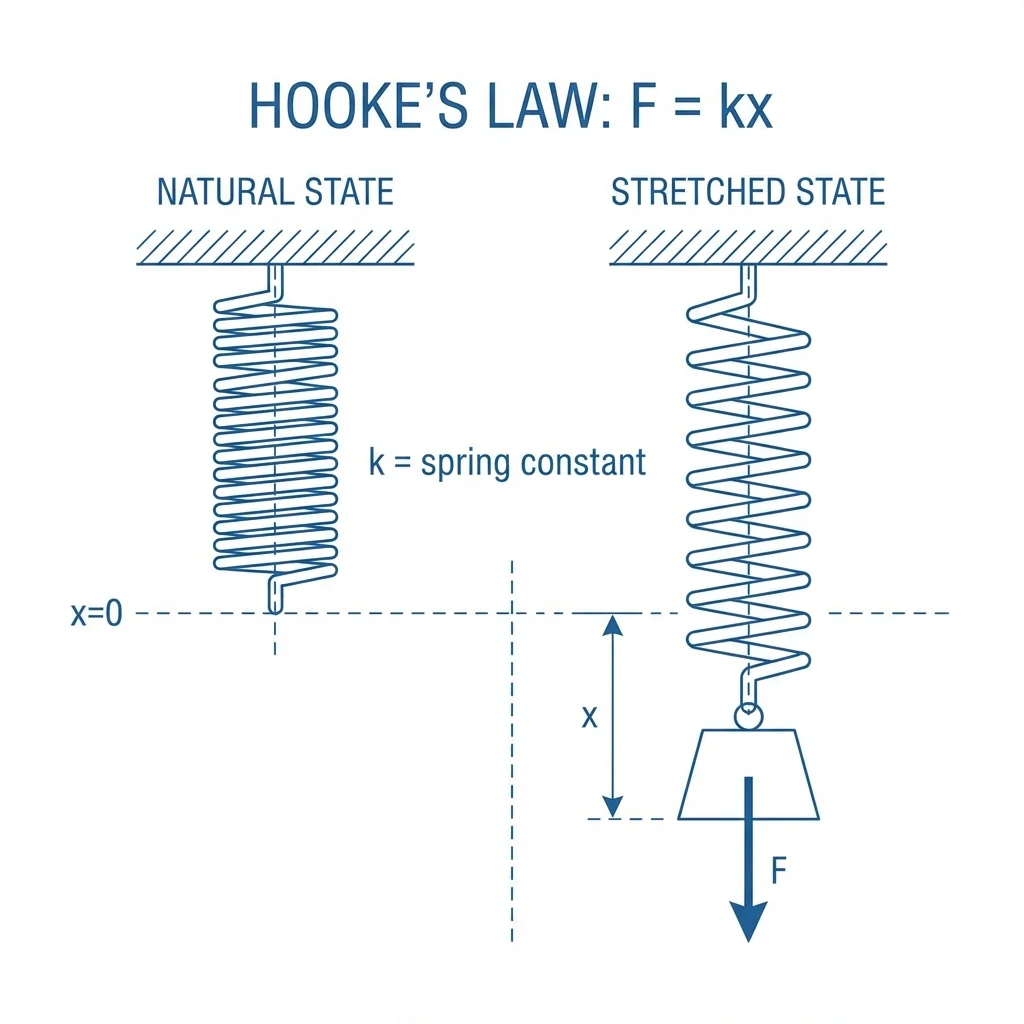
Figure 1: Visual comparison of a spring in its natural state vs. under a load F.
Elastic Potential Energy
When you compress or stretch a spring, you are doing work on it. This work is stored as Elastic Potential Energy (PE). The amount of energy stored increases quadratically with the displacement.
PE = ½ × k × x²
Types of Springs
- Compression Springs: Designed to resist compressive forces (e.g., car suspension).
- Extension Springs: Designed to resist tensile forces (e.g., trampoline springs).
- Torsion Springs: Designed to resist rotational forces (e.g., clothespin).
Practical Maker Tips
- Serial vs. Parallel: Connecting springs in parallel increases the effective k. Connecting them in series decreases it.
- Elastic Limit: Do not stretch a spring beyond its elastic limit, or it will permanently deform.
- Units: Ensure your displacement is in meters for the standard N/m calculation.